Hold on folks...this post is gonna be a long one!
As a culmination of what our students learn about tribal missionary work during their time at Interface, we take them on a several day long side trip into a remote location to see first hand the process of planting a tribal church. New Tribes Mission missionaries are working in each of the locations we send the students to, and it's a great opportunity for them to pick the missionaries' brains, interact with tribal believers, and see the realities of this type of work. For most students this is the highlight of their time in Papua New Guinea (PNG) and the point at which a lot of things "click" for them.
As a culmination of what our students learn about tribal missionary work during their time at Interface, we take them on a several day long side trip into a remote location to see first hand the process of planting a tribal church. New Tribes Mission missionaries are working in each of the locations we send the students to, and it's a great opportunity for them to pick the missionaries' brains, interact with tribal believers, and see the realities of this type of work. For most students this is the highlight of their time in Papua New Guinea (PNG) and the point at which a lot of things "click" for them.
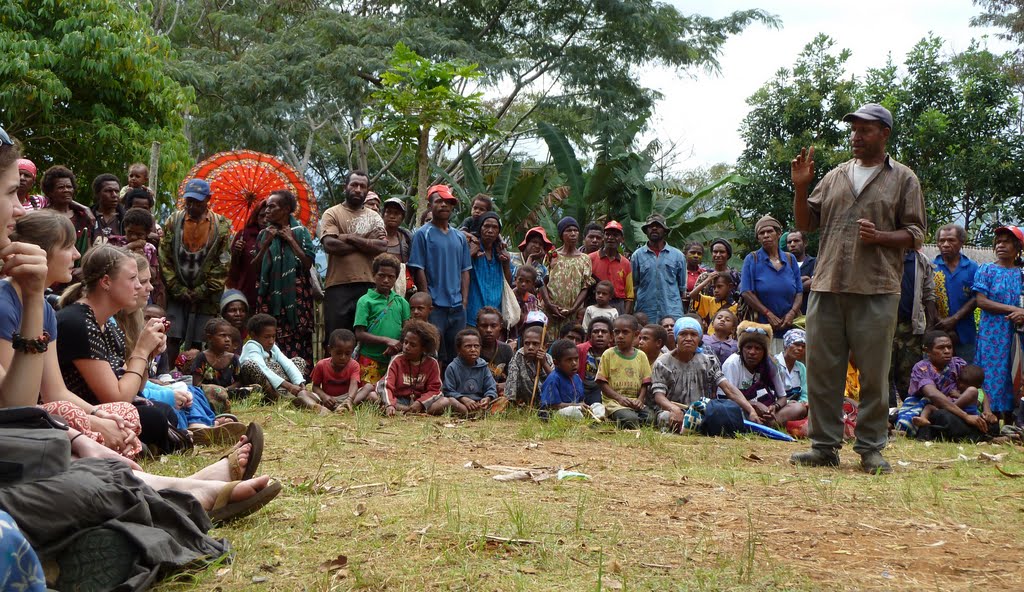
Occassionally I get the opportunity to go along on these trips as a staff leader and to cook for the team, and that was the case several weeks ago when myself and co-worker, Pete (above, pointing out our flight plan), took a group of six students to the island of New Ireland for seven days.

From left: Pete, Matt, Meredith, Elaine, Jess, Kaitlyn, myself and Taylor waiting to board the plane for a two hour flight to New Ireland.
We dubbed ourselves "Ocean's 8" and had visions of swaying palm trees and sandy beaches for the next seven days.

After landing in New Ireland, we still had a 5 1/2 hour truck ride to the village we'd be staying in. The highway followed the coastline for most of the drive and the scenery was spectacular. After two hours of beautifully paved road, though (something foreign in the Highlands where we live), the pavement abruptly ended and it was gravel, rocks and potholes for the next 3.5 hours. The missionary that we'd be staying with was along for the ride and when I mentioned to her how impressed I was that they put up with this each time they travelled she just said, "It's worth it." Enough said. I was humbled by her attitude towards this difficulty because of her love for the people she works amongst.

We took a couple stops along the way to feel the sand between our toes.


We finally arrived, with sore bottoms, and I was impressed with how prettily the people sold things along the road. Buai (pictured) is a staple in most areas of PNG although not because of it's nutritional value. Eaten the right way, it gives you a mild buzz and the people say it gives them strength to work.

Freshly dug peanuts.

This was home sweet home for us for the next week (the missionary couple normally living there were home in the States). I have to admit, it wasn't bad waking up to waves crashing on the beach each morning.

There's our host, Madonna, smiling at the camera. She was an incredible host and an insanely hard worker and she kept us busy the entire time.

Once we settled in to our house for the week, we were taken on a tour of the village. This poor guy was off to get eaten soon.

Because a main road runs right through this area, there are several churches that have settled in over the years. While having an outward show of knowing Christ, they all generally teach the same message of having to work for salvation which is common around PNG.

During our drive we had noticed several of these horn-like structures along the way. When we asked Madonna what they meant, she told us that the closest she can figure is that they're some kind of protection from evil spirits. In this case, the cross of Jesus Christ was not enough...they needed to put the other symbol there as well to protect the cross. Heartbreaking and ironic, seeing as the verse on the cross here says, "For the message of the cross is foolishness to those who are perishing, but to us who are being saved it is the power of God."

That's one big pig.

The students are introduced around the village and they get a pretty excited welcome. In our villages around Interface the people are so used to seeing students and missionaries that it's not a novelty to them anymore. But you could tell that we were special guests here and that was a lot of fun.


You can't quite see it but there were dolphins playing in the water off the coast. That was a first for me and it was beautiful.


The "Haus Boi" (Boy House) is a pretty big deal in PNG. This is where many of the young, unmarried boys live until they find a wife. There are rules and taboos to haus boi's, including when women can enter, and I was surprised that they invited us right in to this one to check it out. You can often tell a haus boi by the enclosure around it, in this case a rock border.

Pig jaws lined the ceiling from all the ceremonies that had taken place over the years. You can tell how old they are by how blackened they are from the cooking fire smoke.

Taking some time to relax underneath a house. Each family generally has a cooking house (on the ground) and a sleeping house (on stilts in this area). Building your house off the ground makes for cooler sleeping. We didn't realize there was a baby sleeping in that hammock behind me (below)!


Tika was our tour guide for our first foray into the jungle. She wanted to take us to her garden, which happened to be on top of a mountain. These ladies are wonder women and put us to shame with their hard work and seemingly super-human strength. They were sweet to us and stopped for breaks several times on the way up. Along the way Tika chopped down a few palm brances and showed us how they make baskets/purses.

Starting from the spine they weave the palm leaves together and seal it up, then they split open the spine to open it into a basket. Pretty brilliant.

While Tika was working her basket magic, a few young boys went scrambling up some trees to fetch us some coconuts to drink.


The meat on the inside of a young coconut is still moist and soft and pretty tasty.

We finally arrived at the garden (on a crazy steep incline) and started digging for sweet potato.

Tika and another lady with us stuck a fern in their hair before coming down the mountain. They said it was just for decoration so I did the same, and was surprised to hear people say, once we got down, "Oh, so you've been in the garden?" Apparently when someone's been in the garden they put a fern in their hair to let people know.


Elaine was excited to find an entire book of Sherlock Holmes stories in the house we were staying in, so almost every night we'd sit around and relax while she read to us. Our days were pretty packed with events around the village, and after supper we'd spend some time talking with Madonna and discussing her work. So at the end of the day we were pretty exhausted and ready to crash.


Some kids taught us how to make toys out of palm leaves. So creative!

On Sunday we had the opportunity to check out one of the local churches to see what that service looked like. They sure got their use out of these books. The singing here blew me away in its beauty. It was loud and full of parts and harmonies and when the kids jumped in it was incredible.

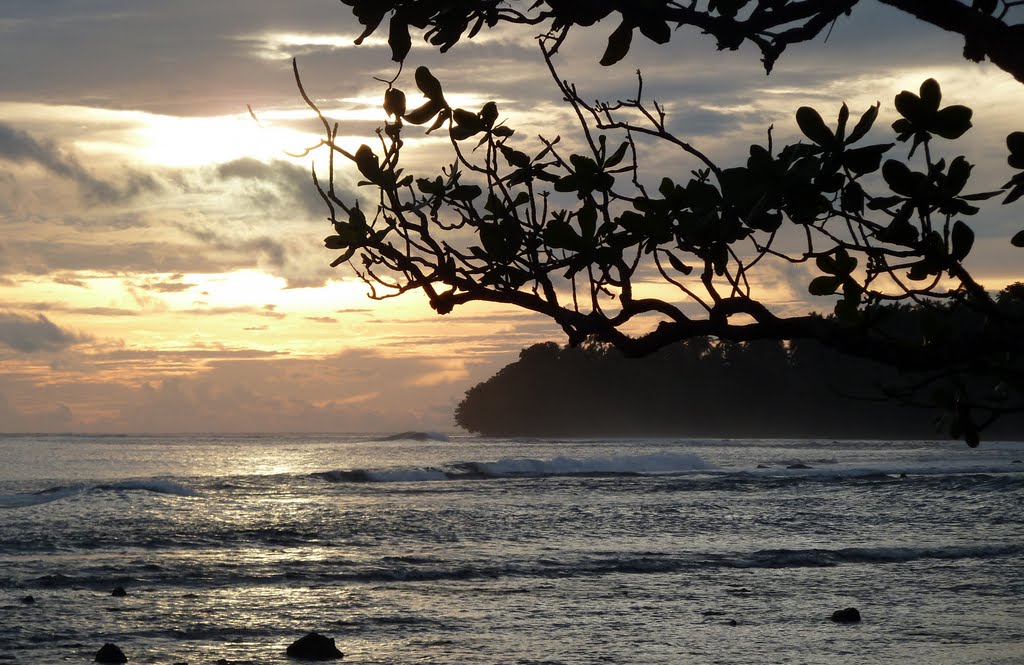
There's nothing quite like an ocean sunset.

Ocean's 8!


I know, how many sunset pictures do I need to post, right? Be thankful I didn't post them all.


Love this guy's shirt. On Monday we headed to another village to sit in on the believers' meeting. This group of men and women is the fruit of the chronological teaching (starting from creation and teaching through to the cross) taught by the missionaries in their heart language. The aim is to continue teaching and discipling these believers in order to raise up teachers and church leaders that will take over the work. Although the translation of the Bible and continuing to encourage and disciple believers takes many years of commitment, as far as teaching goes missionaries want to work themselves out of a job. The goal is to build up and nurture a tribal church, and then to gradually pass it into the hands of the believers themselves so that it's a truly indigenous church.


When the missionaries arrived in this area they discovered that there had already been an existing New Testament in the heart language that another organization had completed more than 10 years previous. Since the organization had finished the translation but not taught the people how to read it, though, the translation sat unused for all those years. Now, those who have chosen to attend literacy classes are able to read and understand their heart language. And that book that used to be jibberish is now coming alive as the Word of God.
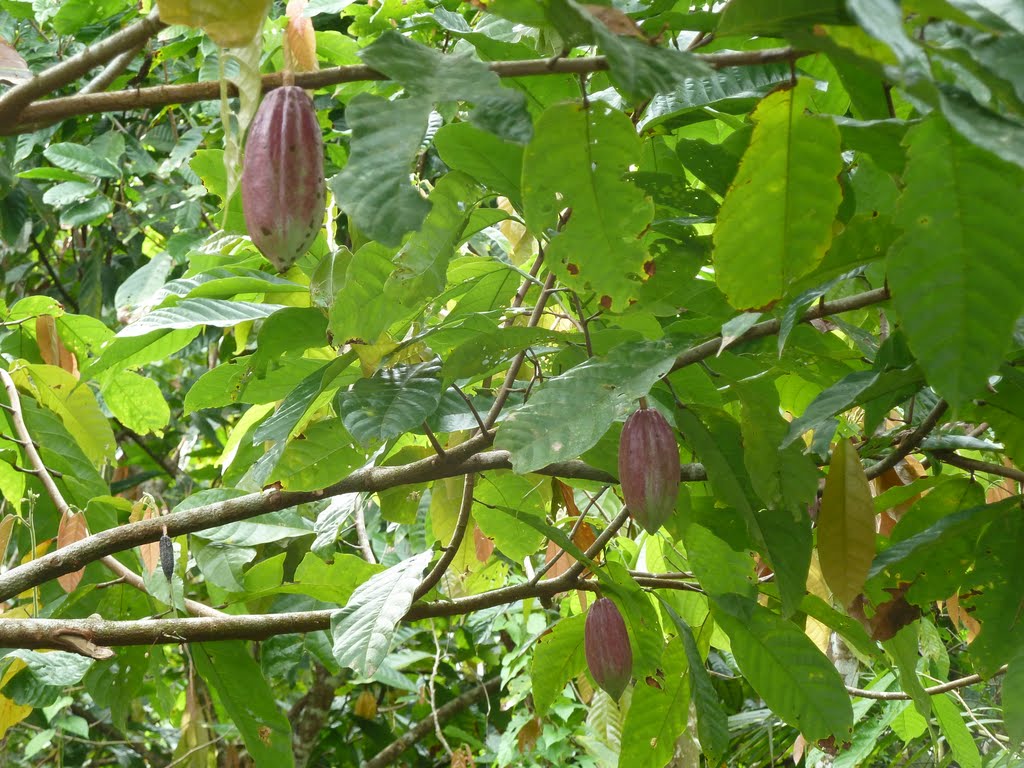
You can thank this tree the next time you enjoy a chocolate bar or a nice mug of hot chocolate. This area was full of cocoa trees.


We asked a local lady, Lucy, to help us collect some firewood one day. How long can it take to collect a few sticks, right? Well the next thing we knew we were trecking up the mountain through the jungle, passing by seemingly good wood all along the way. I wondered if Lucy really understood what we wanted or if she just thought we needed some exercise. Eventually she disappeared in front of us and all we could hear was her machete chopping wood in the distance. So we sat around exploring the bush around us and came across these funky creatures. At first it just looked like some fuzz on a branch, until the fuzz started to move. Weird! I still have no idea what these were.


We thougt we were amazing bush women but I'm sure Lucy was laughing at us the whole way.

We decided to cook hot dogs over the fire one night. A few of the villagers decided to invite themselves over for supper and we had a great evening hanging out and sharing favorite songs in all our languages.

The villagers don't use much more than a few hot coals to cook their food, so they were surprised by the huge roaring fire we had going by the end of the end of the evening.


One morning we got a chance to stop by the village where the literacy class is taking place. This was by far the highlight of my time in the tribe. There was something incredible about seeing adults learn to read and write their own language. And when I thought of the Bible sitting in their hands for 10 years with no way of reading it, it gets me excited thinking of them opening it up for the first time and making sense of what was inside.


This is a local Aid Post in the area.


Madonna was helping this lady learn how to text on her cell phone. There something about seeing cellphones and thatched huts in the same place that you never quite get used to.

We walked pretty much everywhere we needed to go but once in a while we got a treat and took a ride. The man in the forefront grew up a very "religious" man, but it wasn't until recently that he really understood what Christ's work on the cross meant for him. Madonna said that the changes in his life were drastic. He's now joyful all the time and he knows the peace of not having to work for your salvation.

When us ladies were in the garden one day, Pete and the guys headed to the bush to collect coconuts...as you should have been able to tell by the fern in his hair (and all the coconuts).

A lady fishing off the reef. Nope, no fishing rod - just a piece of fishing line in her bare hands.

One thing that's always interesting with new groups of students is seeing what fads and sayings are "in" at the moment. We're pretty far removed from all of that over here and it's funny how fast the fads change. Homeslice, homeskillet, fershizzle...I'd learn them all one program and the next they'd be out of use already. Apparently, everything's "YOLO" these days...You Only Live Once. Example, if a friend is trying to make a decision, you might tell them "YOLO!" So our team adopted the slogan "YOPO!" - You're Only in P----- Once (the name of our tribe started with a P). Madonna is an incredibly hard worker and she kept us going the entire week. We'd come back from an exhausting morning out in the village and be ready to flop on the couch and sleep when Madonna would come by with another opportunity to do something. Although exhausted with no energy to keep going, inevitably someone would say "YOPO, you guys!" and they'd all get up and push through.

The morning that we were leaving P----, one of the men who'd been hanging around with us all week was waiting outside and all of a sudden said "I'm going to go get a fish!" Um, ok. Half an hour later he walks up with this! It was super creepy (and pretty cool) to be touching a shark head that was alive just moments before. It still gives me the shivers.


On the drive back we stopped at this coastal town to fix a flat tire. Thirty bucks and one patch later we were on our way.

This dump truck was proud to be PNG, apparently.

The road we were driving on was so bumpy that we didn't notice that our newly patched tire was patched no longer and was being ripped to shreds. While the men worked on the tire the ladies took a trip into the great outdoors to find a bathroom.

This vendor along the way was selling oranges, buai, kulau (young coconut to drink), and other fruit.

We only had to experience driving this route once to get in and out of the village, but we were so thankful that the missionaries, who make this trip often, have decent vehicles to make a long and exhausting trip a bit more bearable. Our 5 1/2 hour return trip that day turned into 9 1/2 hours on the road (flat tires, blocked roads, etc.) so we were especially grateful for comfy seats and air conditioning!

There was a massive waterfall behind those trees but you weren't allowed to see them close up unless you paid (so says the sign). I think it was about $25 a person. No, thanks!

Big tree.

One thing we didn't want to pass up was visiting Cathy and her eels. $2.50 a person was a bit more reasonable and there's nothing quite like having wild eels gliding through your legs. Having made this trip last year and finding out that the eels only like to be fed a certain brand of fish, I came prepared this time around with eight tins of Besta tuna. I was pretty proud of myself until Cathy mentioned that it has to be Besta Mackerel. Right. So after dishing out $3.50 for a tin of the eels' favorite, we made our way to their hang out...a shallow stream leading into the ocean.

As the mackerel is dumped in the water just one or two eels make their appearance, but within a few minutes you can see at least a dozen eels slithering their way up the stream.


Before catching our flight out of Kavieng the next day we stopped in at the local market. I was happy to find one of my favorite snacks - grated tapiok root cooked over the fire. Think McDonald's hashbrown, but better.

One Fish, Two Fish, Red Fish, Blue Fish...

It was finally time to board the plane and head back home to the chilly highlands. With Madonna, our team of Ocean's 8 became Ocean's 9. Before we began our trip we had sandy beaches and palm trees on our minds. As we left to return home, though, we said goodbye to a lot more than that. We had so many great and stretching experiences, met some amazing people (missionaries and citizens alike), and left with a greater understanding of God's heart for people and a challenge to our own lives.